
Final Fantasy VI - Thoughts

Final Fantasy VI, released as Final Fantasy III on the SNES in North America, first launched in Japan in April 1994 and reached the U.S. in October 1994, arriving late in the Super Nintendo’s life but making a pretty immediate case for itself as one of the system’s crown jewels. Developed by Square, it pushed the series further toward a bigger ensemble cast, a more cinematic story, and a world that mixed fantasy with machinery in a way that felt both strange and cool. Instead of building everything around one hero, Final Fantasy VI spread the spotlight across a large cast of characters, which gave the game a broader, more epic feel than a lot of RPGs of the era. It was also the last mainline Final Fantasy built around 2D sprite work, ending a beloved era for the series.
Nerd Central has over 200 subscribers! Click the button below to get a free month of paid content!
Critically, the game was met with widespread acclaim. Reviewers at the time praised its graphics, music, emotional storytelling, and the sheer scale of the adventure, with Electronic Gaming Monthly giving it multiple 1994 awards including Best Role Playing Game, while GamePro called attention to how well its characters, plotlines, and branching scenarios all came together. Over the years, that reputation has only grown, and Final Fantasy VI is still regularly treated as not just one of the best entries in the series, but one of the defining JRPGs of the 16-bit era.
Sales-wise, the game was a success, despite not knowing exact sales figures. It was reportedly the best-selling video game in Japan in 1994, and by March 2003 the SNES and PlayStation 1 versions had shipped 3.48 million copies worldwide, with 2.62 million of those in Japan and 860,000 overseas. So while Final Fantasy VI may not have hit the ridiculously huge numbers of some later entries (Final Fantasy VII), it absolutely performed well and has long since earned its place as one of the most beloved games Square ever made.
What I Liked 😁
Narrative Worthy of a Bard
Personally, Final Fantasy VI holds a special place in my heart despite never having rolled credits as a kid. I’ve talked about this in some of my paid posts, but I spent a lot of time with my cousin as a kid. He had all the cool stuff: a computer that ran Window 95 (woah!) with tons of games and a SNES. I was a Genesis kid and so I had to get my fill of Nintendo RPGs at his house. Along with other single player only games like Chrono Trigger, we would take turns playing the games and it was a blast.
Fast forward to now and I have finished the game and I am so happy that I got the chance to do so. Not only to fulfill my childhood desires, but to experience the game and its wonderful story. Be warned, I am going to be gushing all over this game similarly to my Final Fantasy IX post.
Final Fantasy IX - Thoughts

Released for the Sony PlayStation in the year 2000, Final Fantasy IX marked a nostalgic return to the series’ medieval fantasy origins after the futuristic science fiction-esque settings of Final Fantasy VII and VIII. Developed by Square near the end of the PlayStation’s life cycle, the game was directed by Hiroyuki Ito and produced by series creator Hi…
Even if Square Enix made total garbage games for the rest of the time we have left on this Earth, their work on Final Fantasy VI would still keep them at the top of the list of the best JRPG game developers of all time. Their ability to get so much comedy and sadness and joy out of a 2D sprite based video game is monumental to say the least. Okay, I’m rambling, let’s add some structure.
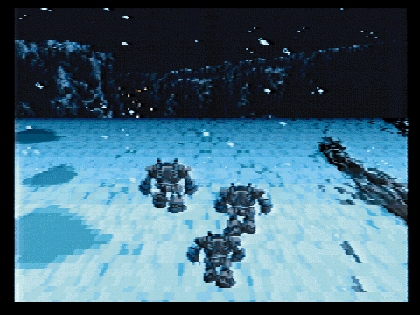
What is the story of Final Fantasy VI? Well, to keep it concise, Final Fantasy VI is a story about a world where magic used to flourish. There was a war and after the war, magic was nowhere to be found. Fast forward quite a long time and magic is now considered a legend or myth. The world, now filled with technology and science instead of magic, is essentially controlled by one empire who has somehow discovered a way to harness this legendary magic. The story begins for the player with a mysterious girl in a mech suit and a group of rebels who are fighting this mighty empire. The game’s story expands from there and takes you on an adventure with a huge cast of characters.
The story is not just about good versus evil. That would be too simple for a Final Fantasy game of this caliber. No, the story touches on the obvious resisting of tyranny but also confronting despair, finding hope after loss and the existential question of what is the meaning of life if the world is in ruin. All of these themes are conveyed through the myriad of characters that the player gets to play as and interact with. Let’s touch on some of those now.
Warning, there could be spoilers.
Terra is the first character we meet. She is being controlled by the Empire via a device that was put on her head. It turns out that Terra is human but also part Esper. The Empire discovers that Espers are the source of the lost magic in the world. Terra spends the game trying to figure out why she is different and coping with her differences along with finding friendship and love.
Cyan is a mighty knight of the kingdom of Doma. Cyan’s kingdom and entire family is destroyed at the hands of the Empire. Cyan’s story is dark but through that darkness, he discovers the will to survive and cope with survivors guilt.
Shadow is a mysterious assassin who looks like Snake Eyes from G.I. Joe. He is a silent character and seems motivated mainly by money. As the game unfolds, it becomes clear that he is haunted by his past identity as a man named Clyde and by the people he failed.
That is only three of the characters and there are many more who have just as interesting backgrounds and stories, if not more. I also appreciated that there are NPCs who have arcs that are sometimes just as complex as our main crew. There are characters who are working for the Empire but struggle with the actions being taken. It brings a realism to the game: just because you are on the “wrong” side doesn’t mean you are evil. Things such as loyalty, fear and love can cloud thoughts and affect decisions.
The Espers
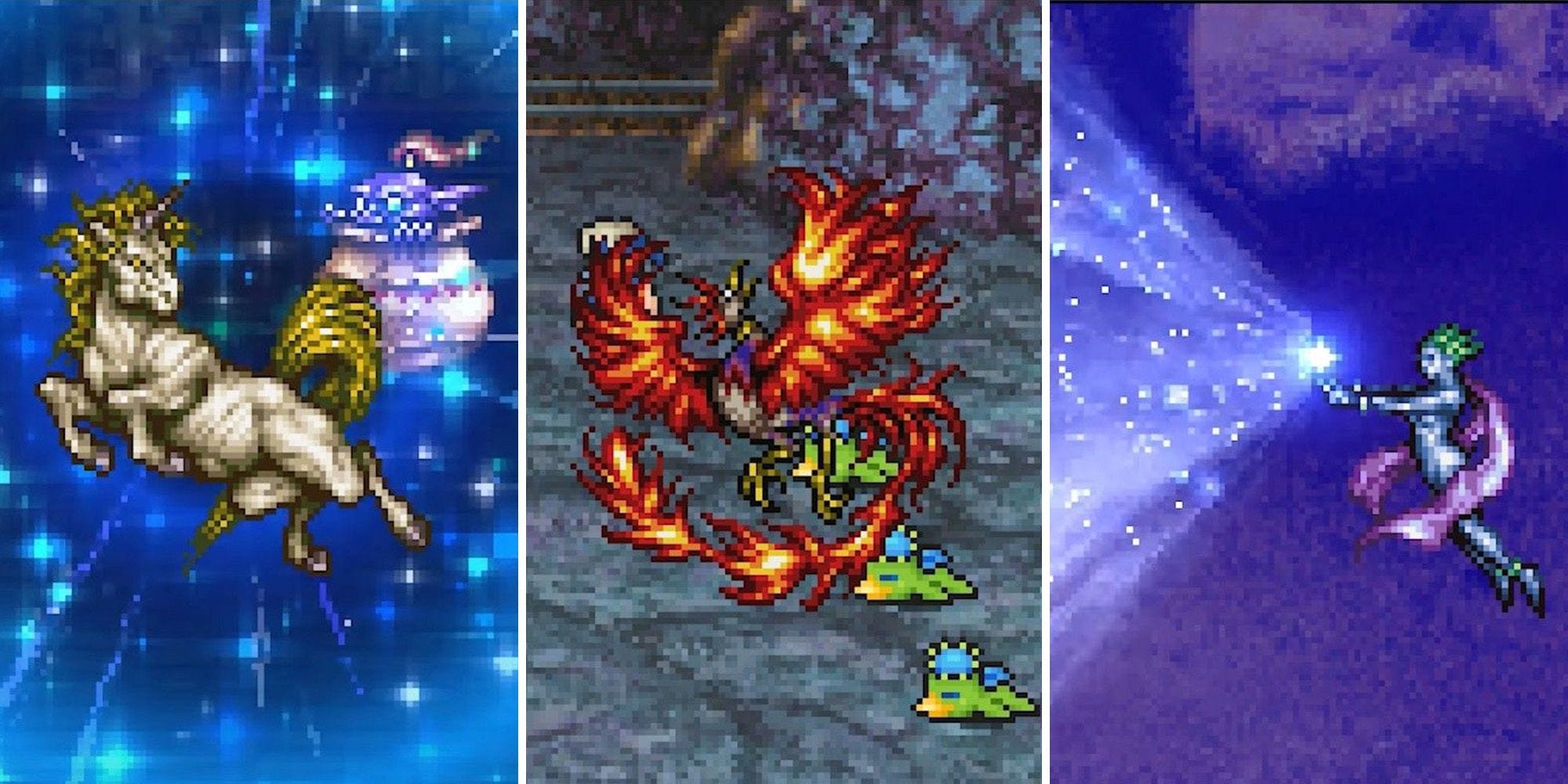
Not much to say here except that I really enjoyed the concept of the Espers, a race of beings who used to live alongside humans but were forced to seal themselves in another realm after the War of the Magi. They are the catalyst for the story as The Empire has figured out that the Espers exist and where they are located. With their magic, The Empire is able to build Magitek weapons and bend the world to their will. It’s a tragic story because not only are the Espers discovered, but they are killed and forced to give up their power in order to be used for evil.
Unique Skills
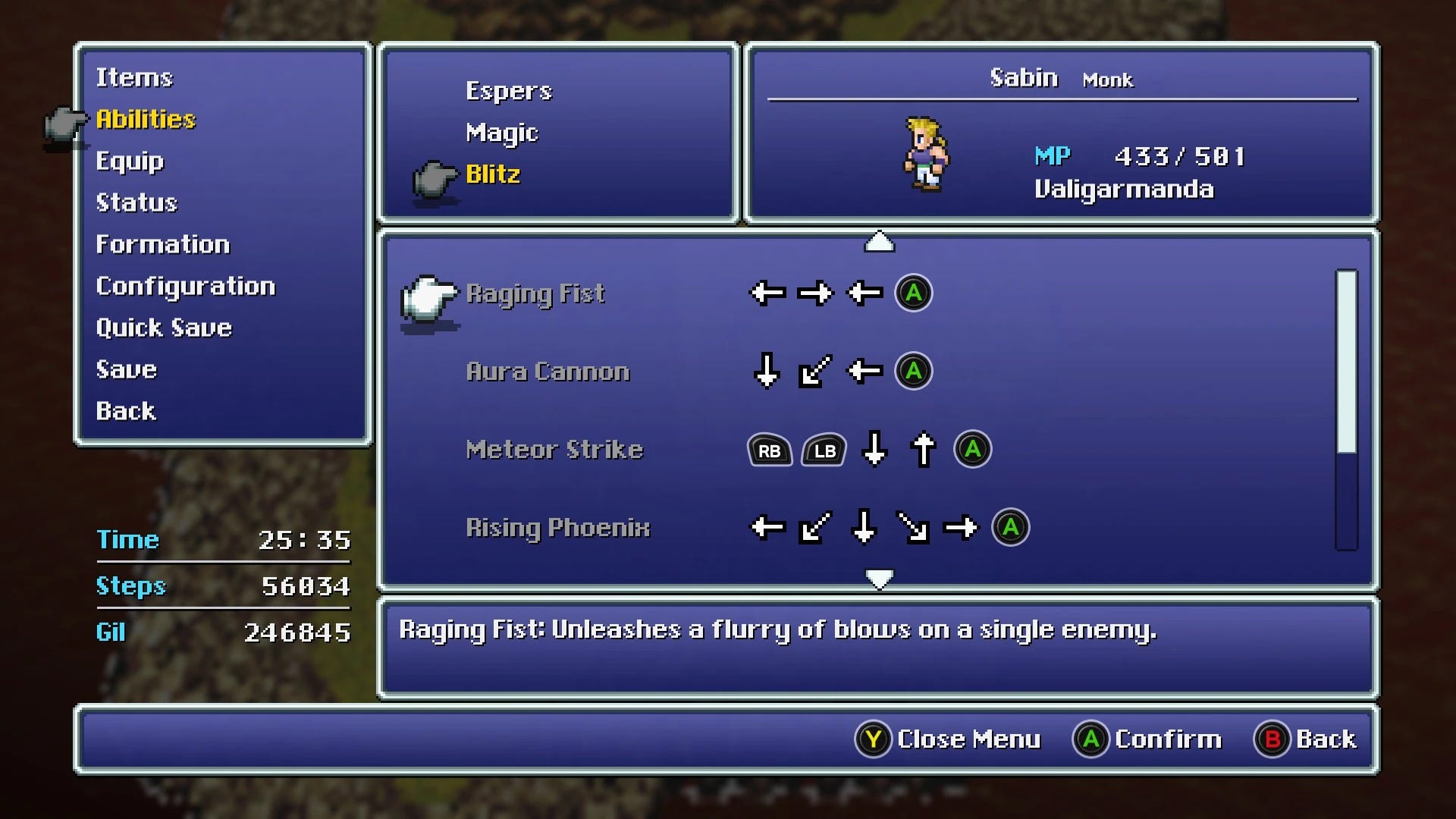
The story is great, yes. The characters are interesting and deep, sure. But what about the gameplay? Well, it’s great too! Specifically, the variety of unique skills each character possesses, making them stand out instead of feeling like a palette swap. Cyan is a blade master and so he can “charge” up his attack to perform different abilities. Edgar, one of my favorites, can use tools which range from crossbows, chainsaws and a gun that shoots this green poisonous goo. Setzer has a Slots ability in which you literally run a game of slots to see what he will do on his turn. It’s random but also super fun. Relm has an ability called Sketch that can be used to copy enemy attacks.
It’s super fun to use these abilities throughout the game and keeps the typical RPG grind from feeling so grind-y. But at the same time, each skill makes sense for the characters based on who they are and where their strengths lie. Locke has the Steal ability because he’s a thief. Terra can tap into her Esper abilities with Morph. And Shadow can Throw shuriken and swords at his enemies. You won’t see Terra stealing anything and you won’t see Shadow casting a Fire spell and that is how it should be.
Music
Maybe more than any other Final Fantasy, the music track of the game is nearly ubiquitous to video gamers. That’s because it’s some of the best video game music to ever be created. Terra’s Theme alone was enough to put the game in the upper echelon of game music. But aside from that, there’s Aria di Mezzo Carattere, the music that is played during the Opera section and Dancing Mad, Kefka’s theme. That’s just three of the tracks that a lot of people (including myself) think are some of the best. But the entirety of the game’s music is full of solid music that people listen to outside of the game. If you haven’t played the game and don’t have the time, at least go to YouTube or Spotify or some other music service and give it a listen.
What I Didn’t Like ☹️
Coliseum and The Veldt
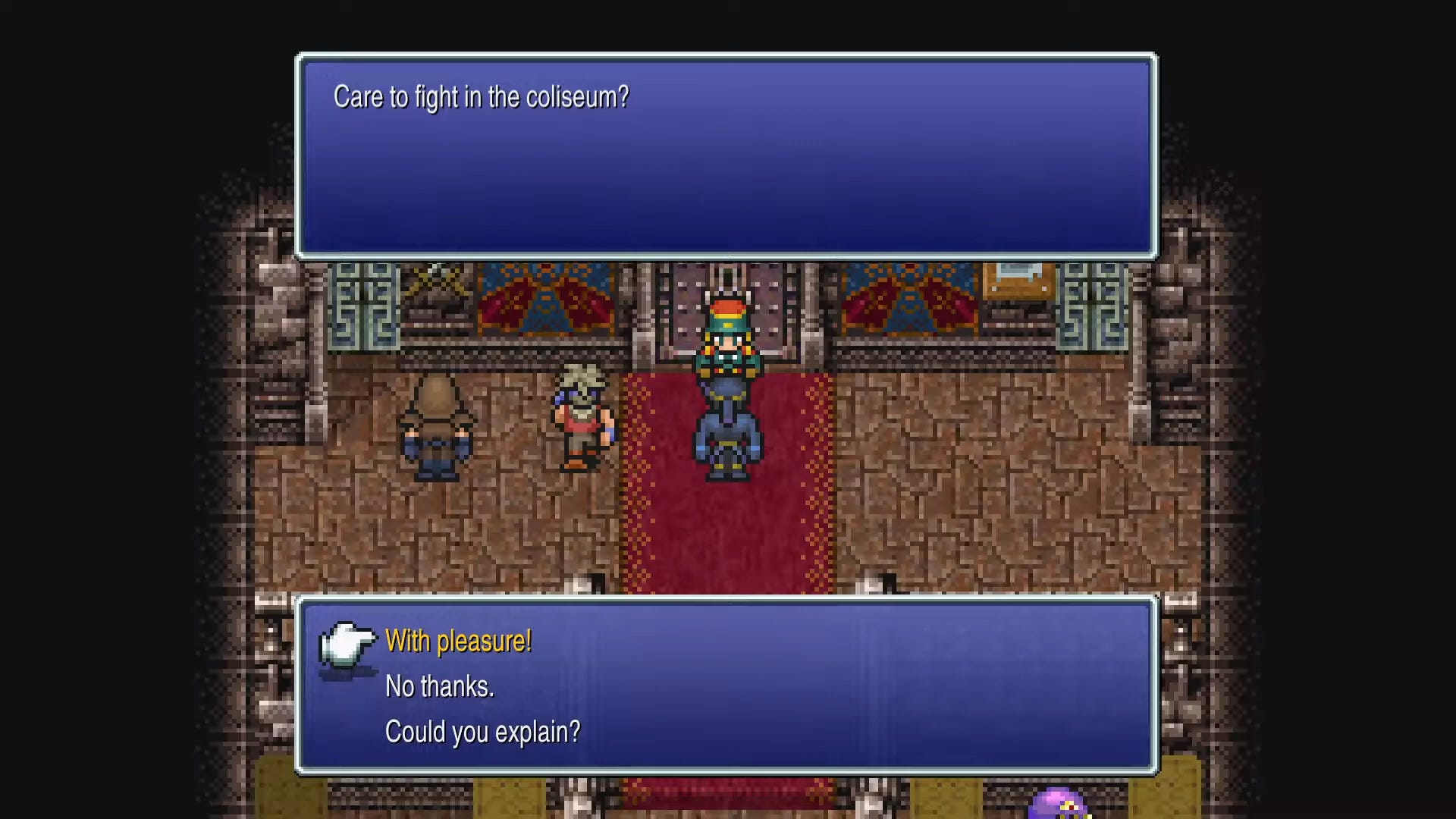
Probably the worst parts of the game by far, the Coliseum and the Veldt are two odd areas that are grind heavy and start to lose their appeal quickly.
The Veldt is a required area where the party recruits Gau, the little feral boy who can learn other enemies abilities. The Veldt is a section of the map that, when you are on it, the party doesn’t gain experience. This is also where Gau can learn new monster abilities. When in an encounter, Gau can leap into an enemy. Once that is done, Gau is no longer in your party until you encounter that enemy again, then he leaps out and he has learned a new ability. It’s a cool concept and at first it’s pretty fun. But if you want to use Gau as an effective character, you’ll be spending a lot of time in the Veldt, far past the required amount of time for the story progression. After the 30th time of doing this, it starts to become a real grind.
The Coliseum thankfully isn’t required at all. But it is a place to get some good gear and so it is appealing. At the Coliseum, the player offers up an item. They then choose a character. After that, they enter the Coliseum battle but the player has no control over the fight. It’s completely automatic and purely random. If the battle is lost, the player loses the item and doesn’t win a prize. If the battle is won, then they STILL lose the item they selected at the start but win the prize. Losing an item in addition to the randomness is such an odd choice especially when compared to the rest of the game that feels meticulously created and - for the most part - player friendly.
Overall Thoughts 🤔
Final Fantasy VI, depending on who you ask, is the epitome of Final Fantasy games. It may have been the swan song of the 2D sprite based iterations of the series, but it certainly went out with a bang. It has some of the best music in video games, the characters are interesting and have depth. The story is filled with themes about loss, greed, tyranny and existential crisis. Characters truly go on a journey, and not all together. I didn’t even mention that the characters split up several times to perform their goals, which is super cool. It has some of the most fun turn based gameplay in the series. Only in the Veldt and the Coliseum do I feel that the game feels less than perfect. Otherwise, this game is perfect. There I said it.
Where Can I Play This? 🕹️
The very best way to play Final Fantasy VI today is via the Final Fantasy Pixel Remastered Collection. The development team have done a great job of not touching most of what is great about the game but also adding in little touches like improved particle effects and quality of life upgrades.
I played Final Fantasy VI via the Final Fantasy Pixel Remastered Collection. I completed the game, having done all the side content except for the Coliseum and rolled credits on the main game.
Up Next 🗓️
We’ve reached the end of the main Mega Man series. Next time, I’ll be discussing Mega Man 11!
Thanks for sharing your thoughts on FFVI. This is one of those games that has always eluded me in terms of its appeal. I know I should think it's great and I admire its ambition, but I've just never gotten into it.
Some day I want to return to this son of a submariner and finish it :D