
Mega Man & Bass - Thoughts

Mega Man & Bass was released for the Game Boy Advance in Japan on August 10, 2002, before coming to North America in March 2003. Developed and published by Capcom, the game was actually a port of Rockman & Forte, a Super Famicom game that had originally released only in Japan on April 24, 1998. Because of that, the GBA version was the first official chance many Western players had to experience this odd little entry in the classic Mega Man series.
The game takes place after Mega Man 8 and introduces a new robot villain named King, who steals data from Dr. Wily’s creations and plans to build his own robot army. The big hook is right there in the title: players can choose between Mega Man and Bass as the playable character. Mega Man plays more traditionally, with his charge shot and slide, while Bass can rapid-fire in multiple directions and has more agile movement. That choice gives the game a slightly different tone from the usual classic Mega Man formula, even if the bones are still very familiar: pick a stage, fight a Robot Master, take their weapon, and slowly work your way toward the final fortress.
Reception to the GBA version was generally positive, though not without some complaints. Metacritic lists Mega Man & Bass with a 79 Metascore based on 18 critic reviews, with reviewers praising it as challenging old-school Mega Man action. Electronic Gaming Monthly called it one of the best action games on the GBA, while other reviews were a little more reserved, pointing out that the game did not do much to reinvent the series.
The biggest criticism, especially in hindsight, is that the GBA version suffers from what is called “screen crunch”. Since the original game was designed for the Super Famicom, squeezing it onto the smaller GBA screen made some hazards and enemy placements harder to see. Rockman Man & Forte was already known for being difficult, so the reduced view in Mega Man & Bass can make certain sections feel even meaner than intended.
Sales information is limited. I could not find any reliable worldwide sales numbers, but one commonly cited Famitsu figure says the GBA version sold 91,097 copies in Japan by the week of December 23, 2002. That does not tell the whole story obviously, especially since the Western release came afterward, but it gives at least some sense of its performance. It’s fairly clear this likely didn’t sell over a million copies and probably didn’t even reach half a million units sold.
What I Liked 😃
Looks Great on GBA
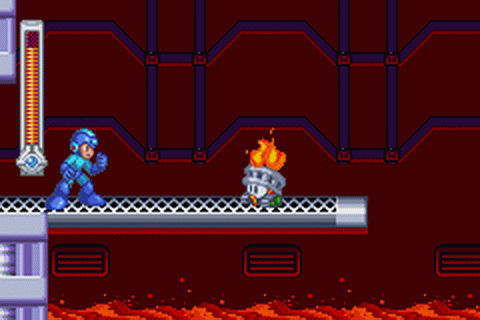
The first thing you’ll notice about Mega Man & Bass is that it looks exactly like a Mega Man entry from the SNES, specifically Mega Man 8. Animations are smooth. Mega Man’s eye blinks when he’s idle, when he jumps he raises one arm up in an effort to get more height. The game’s colors are bright and there’s a ton of anime/cartoon detail. Each level is packed with stuff in the background. If I didn’t have a GBA1 and hadn’t literally inserted the cartridge into the system, I could be convinced this was a Super Nintendo game for sure.
If you’ve ever played Mega Man 8, things will look very familiar. The overall artistic design is cloned almost one-to-one here. In addition, many of the enemies are exactly the same as from Mega Man 8, from the Batton M64 to the Dodonpa Canon to the Rabbiton. Mega Man games recycle enemies all the time of course, but when the visuals are exactly the same as well, it becomes very apparent. Mega Man & Bass even re-uses the Green Devil, one of the mid bosses from Mega Man 8.
Between the Mega Man 8 inspired aesthetics to the excellent visuals to go along with it, I had a great time gawking at everything on the screen. But that was the promise of the GameBoy Advance: a handheld that gave you SNES quality (or better). Sometimes it didn’t always deliver, but in this instance at least in the visual department, Capcom knocked it out of the park.
CD Collection
In other Mega Man games of the past, there either was no collectible or there were bolts or screws. Bolts and screws make total sense from an in-world perspective in which Mega Man is a robot. You need those bolts that act like currency to upgrade his suit, allowing him to jump on spikes temporarily or make his arm cannon shoot faster.
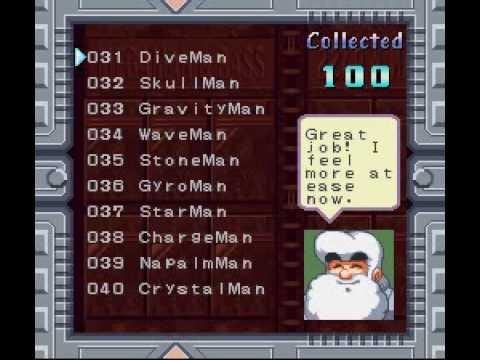
In Mega Man & Bass however, the collectible is not a bolt. Instead, Mega Man is seeking out CDs. Yes, CDs. These CDs contain an encyclopedia of knowledge about characters across the entire Mega Man series including even the Game Boy titles. On these CDs, you will find character images, a short description, a quote and even the character’s likes and dislikes. Much of the information is informative but some of it is meant to be silly or humorous. Unfortunately, collecting the CDs net you zero in-game advantages. The only thing you get for collecting all the CDs is a 100% encyclopedia and the satisfaction that you found all of them. This is no small feat because nearly every stage has to be played more than once as Mega Man and then as Bass (or vice versa).
While there are no buffs or actual benefits to collecting the CDs, I still found it fun to seek these out. Reading the biographies was interesting. It’s also funny to me that we are seeking out CD collectibles on a cartridge based game. I also imagine Mega Man’s chest containing a pull out CD drive so that he can read the data from them. While this little tidbit is innocuous, it still gave me a chuckle.
What I Didn’t Like ☹️
Super Frustrating Final Stages
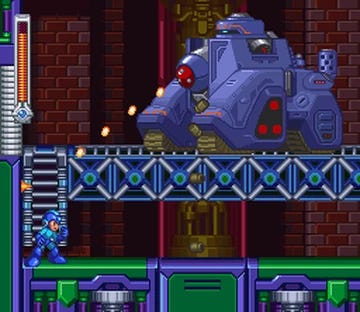
Like most Mega Man games, Mega Man & Bass ends with a collection of fortress stages meant to test your reflexes and all of the skill you have built up from the other stages. I expected the difficulty to increase, after all I’ve played eleven other Mega Man games up to this point, but King’s Fortress was nearly the breaking point for me. These stages combine difficult platforming, instant-death hazards, disappearing blocks, powerful enemies, and several lengthy boss encounters.
The second fortress stage is where things become especially frustrating. It contains five boss battles, including encounters with the King Tank and King Jet before you even reach King himself. Worse, losing all your lives before reaching the main King battle can send you back to the beginning, forcing you to repeat the earlier bosses. Online, you can find similar complaints where some people describe it as a “lesson in aggravation”. That made me feel a little better, knowing that I am likely not the only person who struggled with this part of the game.
The GBA screen does not help of course. Since the game was originally designed for the larger Super Famicom display, the portable version shows less of the surrounding area. That means enemies, projectiles, platforms, and pits may not become visible until you are already dangerously close to them. The entire game is affected by this issue, but most of the game is perfectly playable until the last few stages where the margin for error is already tiny due to the sheer amount of obstacles.
Even after getting through King’s Fortress, the final stage makes you fight all eight Robot Masters again in a predetermined order before facing Dr. Wily. Boss rushes are nothing new for this series, but after surviving the fortress stages, I was already tired. Normally, the Robot Master boss rush feels more like a victory lap. But in Mega Man & Bass, it made things feel like a slog after the crushing difficulty of the King’s Fortress stages.
It’s Not Good to Be the King
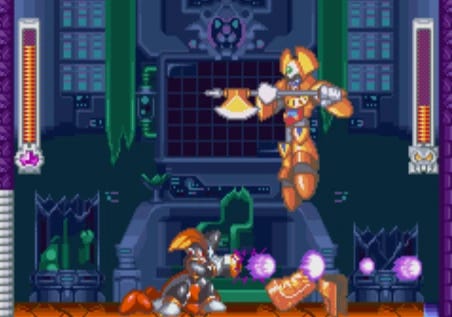
King, the big bad boss of the game, has several phases and they can be pretty confusing. During the first phase, King cannot be damaged at all. You are meant to survive several rounds of his attacks without firing at him. Shooting King only allows him to absorb your energy and throw it back at you as a powerful wave attack. Unless you recognize what the game expects, your natural instinct to attack the boss actively makes the fight harder and likely results in death.
Once you figure this out and once King can finally be damaged, the fight still requires very precise movement. As Mega Man, you must carefully time jumps onto the platform in the center of the room so you can reach the weak point above King’s head. The strategy is different for Bass, who can fire diagonally upward, but he still has to avoid the constant attacks filling the limited space. The smaller GBA display again makes the arena feel even more cramped and can make King’s attacks harder to anticipate.
I do not mind a difficult final boss, especially in a Mega Man game. Mega Man games are difficult, that’s all there is to it. And King is supposed to feel like a major threat. The problem is that I reached him after an already lengthy series of stages and boss fights, making it harder to appreciate the challenge on its own. By that point, I was not thinking about figuring out his patterns or enjoying the spectacle. I was mostly thinking about how much of the fortress I might have to repeat if I died again. And again. And again. AND AGAIN!
Overall Thoughts 🤔
Mega Man & Bass could have been a great game. And, on the Super Famicom as Rockman & Forte, maybe it is. But the GBA port unfortunately suffers from small screen issues that make it very hard to see what is coming up next, be it spikes or enemies or what have you. The end game was extremely difficult for me to the point where I considered giving up. Even still, I think the visual presentation of the game is great and fans of Mega Man 8 will especially like it. CD collecting is a neat little novelty that celebrates the history of Mega Man in a way. Unfortunately, I would recommend Mega Man & Bass only to hardcore Mega Man fans honestly.
Where Can I Play This? 🕹️
As of today, Mega Man & Bass remains difficult to access officially. It was not included in one of Capcom’s Mega Man Legacy Collections and is not currently part of Nintendo Switch Online’s Game Boy Advance library. The Wii U Virtual Console version is no longer available for purchase, leaving an original GBA cartridge or the Japanese Super Famicom release, Rockman & Forte as the primary official options.
I played Mega Man & Bass physically on the Game Boy Advance. I collected several CDs and beat the game.
Up Next 📅
Up next, we revisit SR388 and go Metroid hunting in Metroid: Samus Returns for the 3DS!
Check out this software I created. It’s called GameShelf and it’s basically like a book club but for video games. Get some friends or family, create an account and start playing video games together. You can chat about the game, track your progress, rank the video games you’ve played and more! Use coupon code NERDCENTRAL to get a free month: https://gameshelf.live
I should revise that for clarity. I actually used the GBA Player attachment on the GameCube to play this game, so that could have affected my response to the visuals quite a bit